The key points, at a glance.
- Growing cracks, new puddles, sticking doors and uneven surfaces can be early signs of sinking concrete.
- Inspection should distinguish a local slab problem from movement in the building's footings.
- Track changes and investigate the cause before deciding whether lifting is suitable.
Sinking concrete rarely happens overnight. It usually starts with small clues: a crack that keeps growing, a door that starts to stick, or a puddle that sits where it never used to. Spot those clues early, and you have more repair options, less damage and a clearer picture of the cause.
This guide gives you an area-by-area inspection checklist, simple ways to measure what you see, a severity guide based on Australian building benchmarks, and practical next steps. It covers house slabs as well as driveways, paths, patios and garage floors.
What are the early signs of sinking concrete?
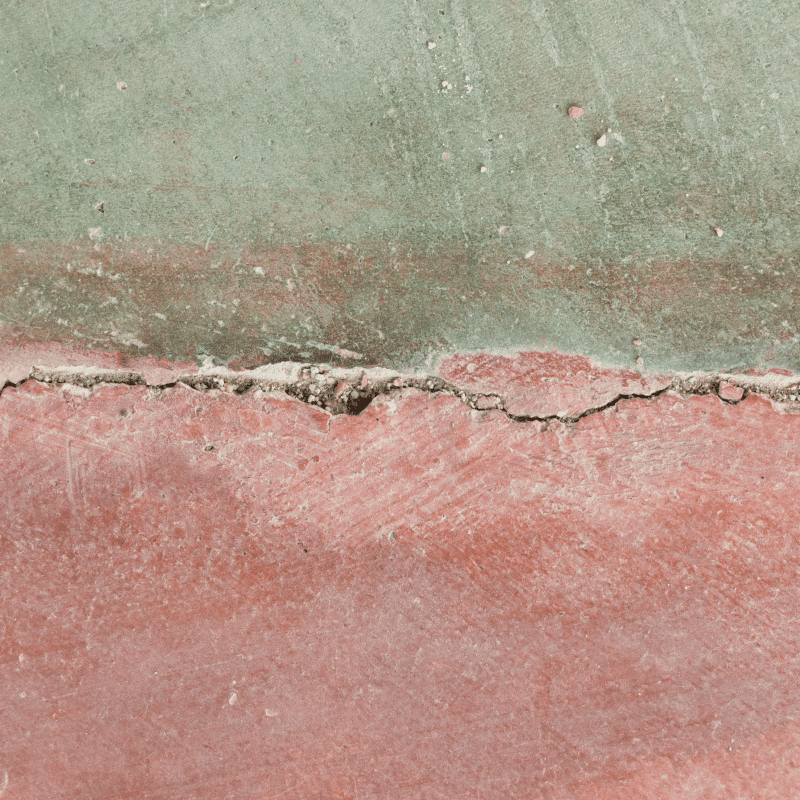
The early signs of sinking concrete are new or widening cracks, a slope or dip you can feel or measure, gaps opening at slab edges, doors and windows that start to stick, and water pooling where it used to drain away. One sign alone is not proof. Several signs in one area, or signs that keep getting worse, deserve a closer look.
Signs inside the house
- Cracks in tiled or polished concrete floors, especially ones that reopen after patching.
- Floors that feel sloped, or furniture that rocks or leans.
- New gaps between skirting boards and the floor.
- Doors and windows that stick, swing on their own or no longer latch.
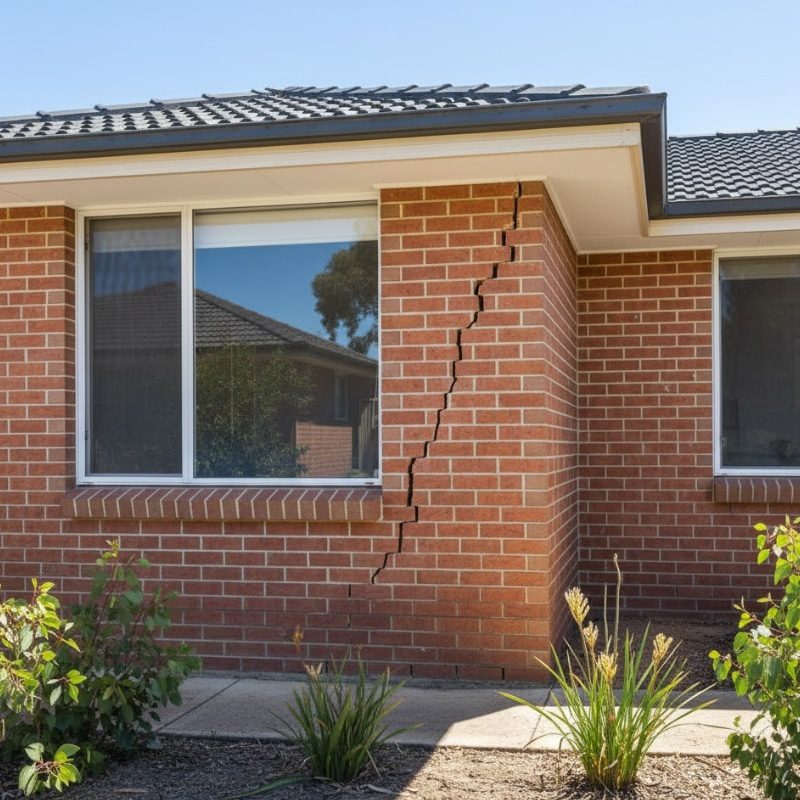
- Diagonal cracks running from the corners of doors and windows.
- Cracked tiles or grout lines opening in one part of the house.
Signs outside: driveways, paths, patios and garage floors
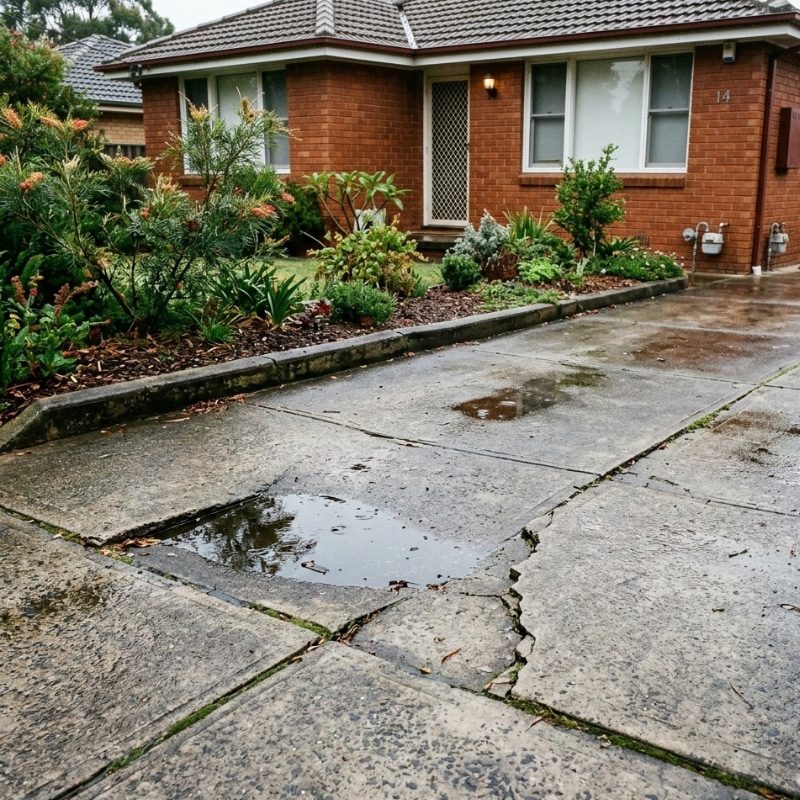
- One concrete panel sits lower than the next, leaving a lip or trip edge.
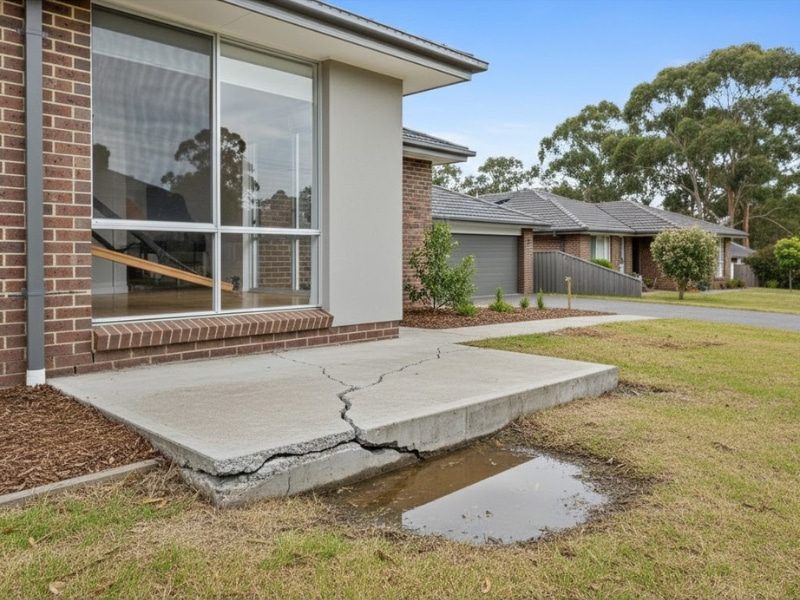
- Gaps are opening between the concrete and the house wall, steps or garage door.
- Water is pooling or running toward the house instead of away from it.
- A hollow or drummy sound when you tap the concrete.
- Steps or path panels that rock underfoot.
- Soil is washing out from under the slab edges after rain.
For outdoor concrete, our guides on why driveways sink and what causes voids under concrete slabs explain the causes in more detail.
Why does concrete sink?
Concrete sinks when the ground beneath it no longer supports it evenly. In Australia, the usual causes are water washing soil away, reactive clay shrinking and swelling, poorly compacted fill, leaking pipes and tree roots drying the soil. The concrete itself is rarely the problem. The soil under it is.CSIRO’s homeowner guide to foundation maintenance and footing performance explains that “all clays react to the presence of water by slowly absorbing it, making the soil increase in volume”. When that clay dries out, it shrinks again. The guide also warns that “even a minuscule leak can be enough to saturate a clay foundation”, and that tree roots near footings can dry the soil enough to cause shrinkage or subsidence.
On sandy or poorly compacted ground, water from a broken or leaking pipe can wash fine soil out from under a slab, leaving a void. Figure 1 shows how that plays out at a slab edge. For more on soil and moisture, read why concrete slabs sink over time.
Figure 1. How a void under a slab edge can make concrete drop and crack. Schematic, not to scale.
Alt text: Cross-section diagram of a concrete slab on soil. On the right, water from a downpipe has washed away soil, leaving a void along the slab edge. The unsupported edge has dropped below its original level, and a crack has formed where the slab bends.
How do you inspect a slab for sinking?
Walk through the house and around the yard with a phone camera, a torch, a pencil, a tape measure and a long straight edge or spirit level. Check each area in the table below, photograph what you find and write down the date. Repeat the same checks after heavy rain and a few weeks later, to compare.
What you need
- A phone camera and a notebook or notes app.
- A pencil and masking tape for marking cracks.
- A ruler with millimetre marks, or a crack width card if you have one.
- A straight edge or spirit level, ideally 2 to 3 metres long.
- A marble or small ball, and a torch.
Area-by-area inspection checklist
| Area | What to check | How to check | What it may mean |
| Living areas and hallways | Floor slope, cracks in tiles or polished concrete, gaps under skirting boards | Marble test, then a straight edge in two directions. Shine a torch low across the floor to show dips. | A low spot can indicate soil loss or movement beneath that part of the slab. |
| Kitchen, bathrooms and laundry | Cracked tiles, grout opening, damp patches, mould, and a jump in your water bill | Look around wet areas and under sinks. Compare recent water bills. | A leaking pipe can soften or wash out the soil under the slab. |
| Doors and windows | Sticking, uneven gaps around the frame, latches that no longer line up, and diagonal cracks at corners. | Open and close each one. Compare the gap at the top and bottom of the frame. | Movement in the slab or footings can twist door and window frames. |
| Internal and external walls | Cracks in plaster, cracks in brickwork, and step cracks along mortar joints | Mark the crack’s end, measure the widest point, and photograph. | Wall cracks often follow movement in the floor or footing below. |
| Garage floor | Cracks, one side lower than the other, and a gap under the door seal | Straight edge across cracks. Check the door seal gap at both ends. | Settlement of the garage slab or its edge. |
| Driveway and paths | Panels lower than their neighbours, lips at joints, panels that rock | Straight edge across joints, step on panel corners, tap and listen for a hollow sound. | Washout, poor compaction or a void under the slab. |
| Patio, pool surround and steps | Gaps against the house, a tilt toward the house, rocking steps | Pour a little water on the surface and watch which way it runs. | Water running back toward the house can feed the problem. |
| Around the outside of the house | Downpipes, gutters, garden beds against walls, large trees close by, washed-out soil | Walk the perimeter during or just after rain. | Water and roots near the slab edge are common triggers for movement. |
How to check a floor for level
Lay a straight edge or long spirit level flat on the floor and look for gaps underneath. Measure the biggest gap with a ruler. Write down the length of the straight edge, the gap and the direction you checked. Repeat across the room in a few directions. A marble is a quick first test, but it only shows which way the floor falls, not by how much.
Figure 2. Checking a floor with a straight edge and a marble. Schematic only.
Alt text: Diagram of a straight edge laid on a concrete floor with a shallow dip in the middle. An arrow shows where to measure the largest gap under the straightedge with a ruler. A marble on the floor rolls toward the low spot.
How to monitor a crack
Draw a short pencil line across each end of the crack and write the date beside it. Measure the width at the widest point, and include the ruler in the photo. Check every few weeks,s and again after heavy rain. A crack that extends beyond your line or widens is still moving. Our guide to house slab movement includes a simple 30-day monitoring plan.
Figure 3. Marking, measuring and photographing a crack over time. Schematic only.
Alt text: Diagram of a crack on a wall or floor with pencil lines and dates marked across each end. A later section of the crack extends past the original mark and has a new dated mark. A crack width card is shown beside the crack for measuring and photographing.
How serious is it? Severity indicators
Most hairline cracks are not a sign of sinking. Cracks that keep widening, level changes you can measure, and doors that start jamming are more serious. The table below uses benchmarks from Australian building regulators and CSIRO to help you sort what you see into low, watch and act now.
| Level | What you might see | Australian benchmark | What to do |
| Low | Hairline cracks in a concrete floor that stay the same. Wall cracks under about 1 mm. No slope you can feel or measure. | QBCC treats hairline concrete floor cracks under 2 mm as acceptable. CSIRO lists wall cracks under 1 mm as damage category 0 to 1 (negligible to very slight). | Photograph, mark and recheck every few months. |
| Watch | Floor cracks close to 2 mm or are slowly widening. Wall cracks up to about 5 mm. Doors are starting to stick slightly. Water pools after rain—a hollow sound under outdoor concrete. | BPC Victoria says slab cracks under 2 mm in new work should be monitored for 12 months. CSIRO category 2 (slight): cracks under 5 mm that are easily filled, doors and windows stick slightly. | Recheck monthly and after rain. Fix drainage and leaks. Consider an assessment. |
| Act now | Floor cracks over 2 mm that keep growing—a level change of over 15 mm under a 3 m straight edge. Wall cracks 5 mm or wider. Doors and windows are jamming. Rocking steps, trip edges, or a hole opening under concrete. | QBCC: concrete floor cracks over 2 mm, and a slab level change over 15 mm across a 3 m straight edge, are not acceptable. BPC Victoria 2026: for new slabs in the first 24 months, more than 10 mm in a room, 4 mm in any 2 m or 20 mm across the footprint is outside tolerance. CSIRO category 3 (moderate): cracks 5 to 15 mm, doors and windows stick, pipes can fracture. | Get a professional assessment. Fence off trip hazards and keep people away from any holes or collapses. |
How to use this table: these benchmarks were designed to assess new building work and describe damage. They are not a diagnosis. A small crack in the wrong place can matter more than a wide one in a garden path. Use the table to decide how quickly to act, then have a qualified person confirm the cause. If your home is new, a defect may be the builder’s responsibility. In Queensland, QBCC says builders are responsible for defects for 6 years and 6 months from the start of work. NSW homeowners can check the NSW Guide to Standards and Tolerances.
What should you do if you notice signs of sinking?
Record what you see, find and stop any water getting under the slab, and have the cause assessed before you choose a repair. Early problems usually leave you with more options. Patching cracks before anyone has looked at them can hide useful evidence, so measure and photograph first.
- Photograph and date everything. Take wide shots and close-ups of each crack, dip or gap. Shoot from the same spots each time so you can compare.
- Mark and measure cracks. Draw pencil lines across the ends, add the date and measure the width (see Figure 3).
- Check for leaks and downpipes. Look for damp patches, mould or a jump in your water bill. With every tap off, see if your water meter keeps moving. Make sure each downpipe connects to stormwater and is not dumping water beside the slab. If you suspect a leaking pipe, call a licensed plumber.
- Keep water away from the slab. CSIRO recommends paving that extends at least 900 mm from the building, with a fall of at least 1:60, and a greater fall on highly reactive clay. Keep garden beds and sprinklers from soaking the soil against the walls, clear gutters, and get advice before planting or removing large trees near the house.
- Seal where water gets in. Open joints and gaps along slab edges allow rain to get under the concrete. If water is coming through cracks in a slab or wall, water-stopping and leak management can seal the entry points once the source of the movement is understood.
- Get an assessment. A ground repair specialist can find what is moving and why. For complex house movement, an engineer listed on the National Engineering Register can give an independent report. For a new home, contact your builder first.
- Avoid quick fixes. Filling a dip with topping mix or caulking a widening crack does not restore the support underneath. The problem can keep moving out of sight.
Is it the slab or the footing?
If the problem is limited to a driveway, path, patio, or garage floor, the slab has usually lost support. If walls are cracking, doors are jamming throughout the house, and the floor slopes toward one corner, the footings may be moving, too. Each needs a different repair, so it pays to know which one you have.
Slab jacking lifts concrete that has lost support underneath it. Underpinning strengthens or deepens footings that can no longer support the house’s load. Our comparison of slab jacking vs. underpinning explains when each is appropriate.
How is sinking concrete fixed?
Sinking concrete is usually fixed by filling the voids under it and lifting it back toward level, rather than ripping it out. At Raise & Relevel, we inject polyurethane resin through small drilled holes. The resin expands, fills gaps, and sets within seconds, after which the holes are patched. We find what is moving, fix the cause, and then the damage.
Our slab jacking service for driveways, paths, and garage slabs also suits patios, pool surrounds, and other outdoor concrete surfaces. For floors inside the house, see our page on sinking floors. Where water has washed the ground out, void filling may come first. For driveways in particular, see our driveway levelling options. We also offer slab jacking in Melbourne and Brisbane.
When lifting is not the right fix
Lifting is not always the answer. If the concrete is badly broken, too thin or crumbling, replacing it may make more sense. If water is still washing soil away, a lift will not last until the water is fixed. If the footings are failing, underpinning may be needed instead. We will tell you if slab jacking is not the right fix for your property.
What affects the cost?
Every job is different, so we quote after an assessment. Cost depends on the size and thickness of the slab, how far it has dropped, how much void needs filling, access, and whether drainage or leaks need fixing first. Our slab jacking cost guide explains these factors, and the concrete levelling guide compares common levelling methods.
Frequently asked questions
Is sinking concrete dangerous?
It can be. Trip edges, rocking steps and holes opening under concrete are safety risks, so fence them off straight away. A slowly sinking path is usually not dangerous in itself. The water or soil loss behind it can spread toward the house slab if ignored, so identify the cause.
Can sinking concrete be lifted back up?
Often, yes. If the concrete is still in reasonable condition, polyurethane resin can be injected beneath it to fill voids and lift it back to level. Severely broken or crumbling concrete may need to be replaced instead. The cause, usually water, also needs fixing, or the problem can come back.
Does a cracked slab mean my house is sinking?
Not necessarily. Concrete shrinks as it cures, and fine hairline cracks are common and usually harmless. Cracks that widen over time, have one side higher than the other, or appear alongside sticking doors and wall cracks are more likely to indicate movement. Monitor them and get advice if they grow.
Who do I call about a sinking slab?
For outdoor concrete, a slab-lifting or ground-repair specialist can assess and repair it. For house movement, a ground-repair specialist or a structural engineer can identify the cause. If you suspect a leak, call a licensed plumber. For a new home, contact your builder first, then your state building regulator if needed.
Does insurance cover sinking concrete?
Sometimes. Insurance may respond to damage caused by a sudden insured event, while damage that develops gradually is treated differently by most policies. Your product disclosure statement decides it. ASIC’s Moneysmart has a guide to choosing home insurance that explains what to check.
Catch it early, fix the cause.
Sinking concrete gives plenty of warning if you know where to look. Walk the checklist, measure what you find and keep water away from the slab. If the signs fall within the watch-or-act-now range, have the cause checked before you choose a repair. A clear diagnosis saves you from paying twice.
Raise & Relevel has relevelled more than 7,000 homes across Sydney, Melbourne and Brisbane. We find what is moving, fix the cause, then the damage, and we will tell you when we are not the right fix. Book a slab assessment or call 1300 053 835 to talk it through.