The key points, at a glance.
- Slab jacking lifts suitable settled concrete, while underpinning supports building footings.
- A dropped path or driveway is different from movement affecting the house structure.
- Diagnosis should establish what is moving and why before a repair is selected.
Slab jacking lifts concrete that has sunk because the ground under it has softened, washed out or left a void. Underpinning provides support beneath a house’s footings, transferring the load to firmer ground. If a path, driveway or patio has dropped, slab jacking is usually the place to start. If the house itself is moving, you need a diagnosis first.
We find what is moving the house, fix the cause, and then the damage. Sometimes that means telling you that you need a plumber, a drainage fix or simply time to monitor, not a repair crew. This guide shows how to tell the two problems apart, what each repair can and cannot do, and what drives the cost.
What is the difference between slab jacking and underpinning?
Slab jacking, also called slab lifting or concrete lifting, raises and re-supports a sunken slab by filling the space beneath it. Underpinning strengthens or deepens a building’s foundation to prevent it from settling. One corrects a slab sitting on poor ground. The other corrects a footing that cannot carry the building.
At Raise & Relevel, slab jacking uses polyurethane resin. We drill small holes, inject the resin, and it expands and sets in seconds, lifting the slab back towards level. Older “mudjacking” pumps a cement slurry instead. Underpinning ranges from traditional mass concrete underpinning to screw piles and deep resin injection, depending on the soil and the building.
| Factor | Slab jacking (slab lifting) | Underpinning |
| What it fixes | A slab that has dropped because of voids, washed-out or poorly compacted fill | Footings that cannot carry the load, or ground that keeps moving under the house |
| Typical areas | Driveways, paths, patios, garage and shed slabs, pool surrounds, warehouse floors | House footings, load-bearing walls, and slabs that carry walls |
| How it works | Resin injected through small holes fills voids and lifts the slab | New support is added under or beside the footings so loads reach stable ground |
| Excavation | None; small drill holes only | Often, some digging beside the footings (method dependent) |
| Disruption | Low; most areas stay usable | Moderate to high, depending on method and access |
| Wrong fix when | The house footing is failing, or a leak is still washing soil away | Only a non-structural slab has dropped, or the cause is a leak that can be fixed |
Which repair does your home need? A visual decision guide
Start with what has moved. A dropped path or driveway, on its own, usually indicates slab lifting. Cracking walls, sticking doors, or a sloping house floor indicate foundation movement that needs to be assessed. A leak or drainage problem comes first in either case, because lifting or underpinning over a wet, washing-out base will not last.
Figure 1. Slab jacking or underpinning decision guide. This is a guide only: the final call is made on-site after inspection, level readings, and leak checks.
The same decision guide as a table:
| If you see this | And this | Likely next step |
| A path, driveway, patio or garage floor has dropped | No house cracks or sticking doors, and no leaks found | Slab lifting/slab jacking is likely |
| A path, driveway, patio or garage floor has dropped | A leaking pipe, broken stormwater or poor drainage nearby | Fix the leak or drainage first, then reassess |
| House walls are cracking, or doors are sticking | Movement is active, and a leak or drainage cause is found | Fix the leak or drainage first, then reassess |
| House walls are cracking, or doors are sticking | Movement is active with no leak found, or you are not sure | Structural assessment: underpinning or resin stabilisation may be needed |
| The house slab or footing carrying the walls has moved | Movement is not clearly active, or the cause is unclear | Structural assessment before any lifting |
Is it slab settlement or foundation movement?
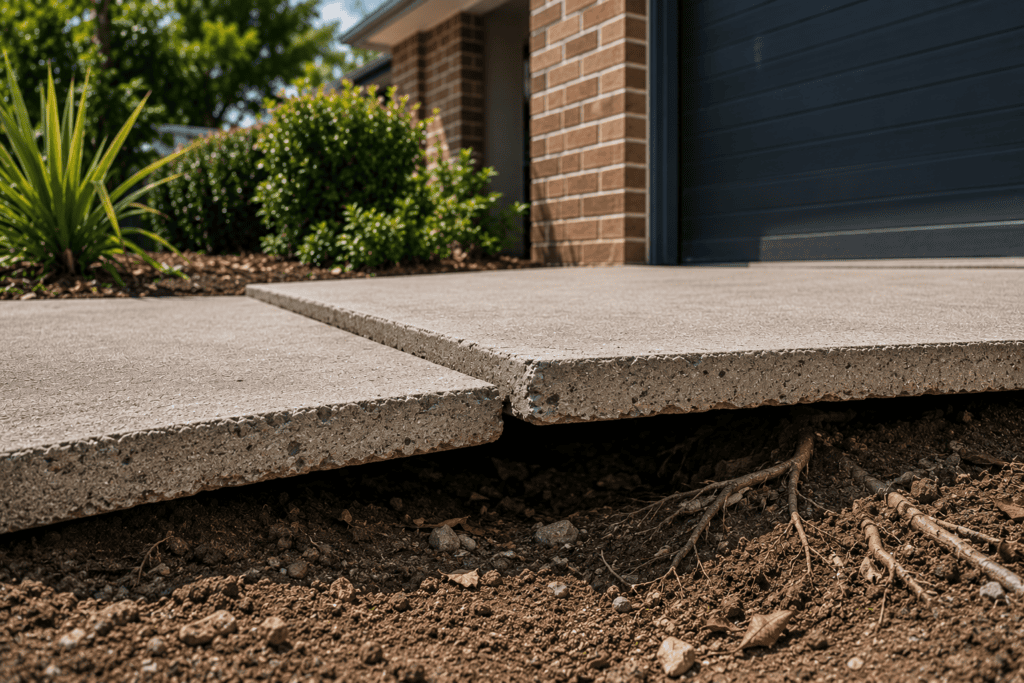
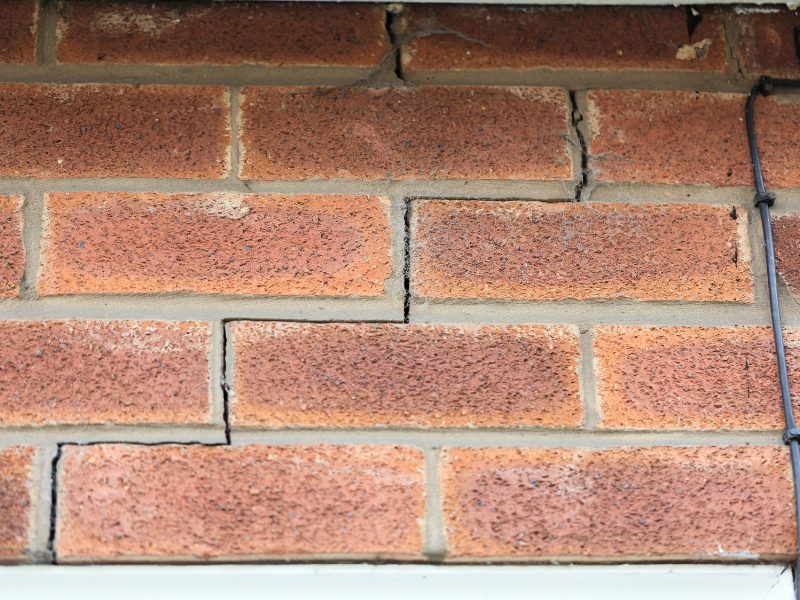
Slab settlement shows up in the concrete itself: trip edges, gaps at joints and water pooling on a path or driveway. Foundation movement shows up in the house: stepped cracks in brickwork, cracks above doors and windows, and doors that stick. Where you see the damage is the best first clue to which repair you need.
| What you see | Where | What it usually points to |
| Trip edge, sunken panel or gap at a joint | Driveway, path, patio, pool surround | Slab settlement from a void or washed-out fill |
| Water pooling against the house or on a slab | Edges of paths and driveways, beside walls | A drainage problem that may be softening the ground |
| Garage floor or shed slab sloping or cracked | Detached or non-structural slab | Slab settlement; check for leaks and voids |
| Stepped cracks in brickwork | External and internal masonry walls | Foundation movement under that section |
| Cracks above the door and window corners | Internal plaster and cornices | Foundation movement or seasonal clay movement |
| Doors or windows sticking, gaps at frames | Inside the house | Foundation movement is often uneven |
| Floor slopes inside the house | Living areas, hallways | House slab or footing movement |
For the full checklist of what to look for and when, read our guide to the early signs of a sinking slab. If the floors inside your home are the main worry, see our sinking floors repair page.
Some movement is normal. Queensland’s building regulator says hairline cracks in a concrete floor under 2 mm are acceptable, but cracks over 2 mm, or a level change of more than 15 mm over a 3 m straight edge, are not (QBCC: protect against subsidence). In Victoria, the BPC Guide to Standards and Tolerances 2026 treats slab cracks of 2 mm or wider as outside tolerance.
How is the problem inspected and diagnosed?
A proper diagnosis measures movement, tracks whether it is still happening, and identifies the cause. That means level readings across the floor, crack monitoring over time, leak and drainage checks, and a look at the soil. An engineer is brought in when the house structure is involved or the cause is unclear.
- Level survey. Readings taken across the slab or floor show which part has dropped and by how much. This separates one sunken corner from a whole house that has tilted.
- Crack monitoring. Crack widths are measured and dated. The CSIRO homeowner guide reproduces the AS 2870 damage categories, from hairline cracks under 0.1 mm (category 0) to cracks of 5 to 15 mm that cause doors and windows to stick (category 3) (CSIRO: Foundation Maintenance and Footing Performance).
- Leak and drainage testing. Water and sewer pipes, stormwater and downpipes are checked. CSIRO warns that “even a minuscule leak can be enough to saturate a clay foundation.” Our water leak management team can locate and seal leaks before any lifting starts.
- Soil information. Many Australian homes sit on reactive clay that swells when wet and shrinks when dry. Tree roots near footings can also dry the soil and cause subsidence.
- Engineer when needed. If walls are cracking, movement is active, or the cause is unclear, an independent structural or geotechnical engineer can design the repair. You can check registration on the Engineers Australia National Engineering Register.
When is slab jacking the right fix?
Slab jacking is the right fix when a slab is in reasonable condition but has dropped due to a void, a soft spot, or washed-out fill beneath it. It suits driveways, paths, patios, garage floors and many commercial floors. It is not the answer when the house footing is failing, or water is still washing soil away.
Where slab jacking works well
- Driveways, paths and patios with trip edges or sunken panels. See our driveway relevelling and concrete lifting solutions.
- Garage and shed slabs, pool surrounds and external concrete.
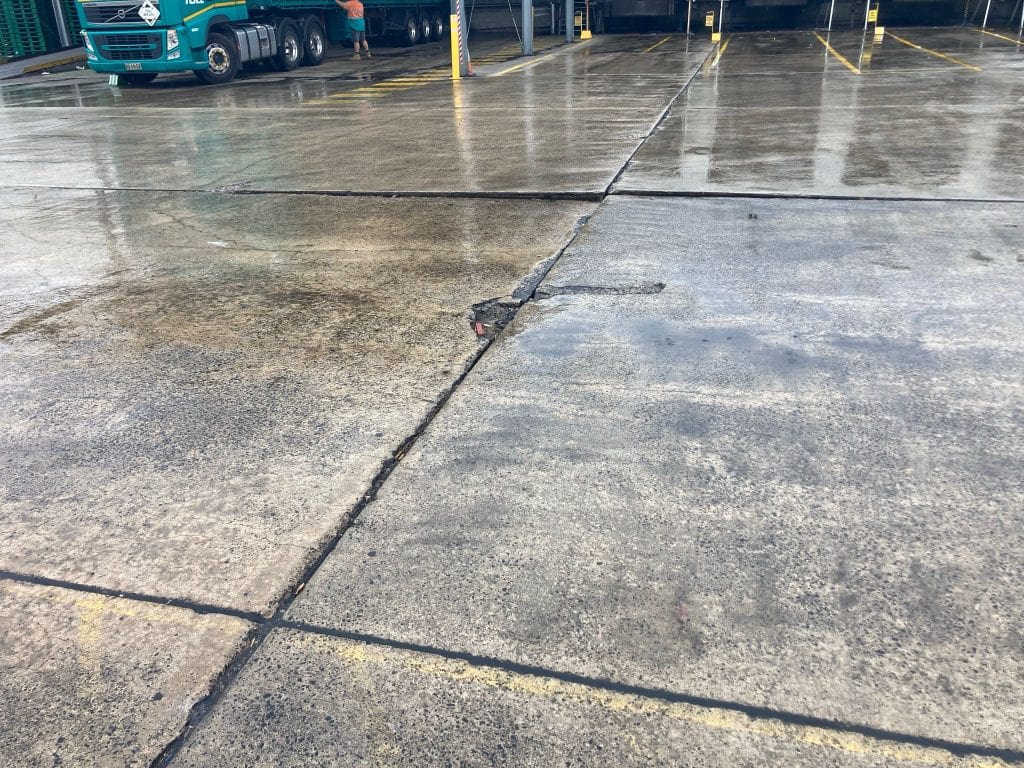
- Warehouse floors and loading zones where downtime is costly.
- Slabs with voids underneath, often after a leak has been fixed. Our void-filling work fills the space before or during the lift.
Our slab jacking process drills small holes in the slab, injects polyurethane resin, and allows it to expand to fill voids and lift the concrete. There is no digging, and most areas can be used again soon after. We work across slab jacking in Melbourne, Brisbane, and Sydney.
Limits of slab jacking
- It does not add support to a failing house footing.
- If a leak or poor drainage is still active, the ground can wash out again, and the slab can drop.
- Badly broken or crumbling concrete may be better replaced than lifted.
- It cannot stop seasonal swelling and shrinking of reactive clay on its own.
When does a house need underpinning?
A house may need underpinning when its footings cannot carry the load to stable ground. Signs include widening cracks in load-bearing walls, doors that keep sticking and floors that keep sloping after a leak is fixed. Underpinning is a structural repair, so it should follow an inspection and, where needed, an engineer’s design.
Where the underpinning fits
- Footings that have settled unevenly and are still moving.
- Foundations on deep soft or reactive ground where the shallow soil cannot carry the load.
- Changes in load, such as a second storey or an extension.
- Ground disturbed by nearby excavation or long-term water damage.
Our underpinning work includes traditional mass concrete underpinning, screw piling and deep resin injection. We assess which underpinnings suit the soil and the house in Melbourne, Brisbane, Sydney, and the ACT. If you are weighing up the two main underpinning options, read underpinning vs resin injection.
Limits of underpinning
- It does not fix a sunken path, driveway or patio that is separate from the house.
- If the cause is a leak or poor drainage, underpinning without fixing the water can still leave problems.
- Traditional methods involve digging, more disruption and a longer program.
- It stops further settlement; closing existing cracks may need separate repair work.
How do the slab jacking and underpinning processes differ?
Slab jacking is a short, low-disruption job: drill, inject, monitor the lift, patch the holes. Underpinning usually starts with an engineer’s assessment, then adds new support under the footings in stages, followed by monitoring and crack repair. The bigger the structural problem, the longer and more involved the process.
| Step | Slab jacking (resin) | Underpinning |
| 1. Assess | Inspect the slab, take level readings, and check for leaks and voids | Inspect the house, take level readings, monitor cracks, check leaks; engineer if needed |
| 2. Plan | Map injection points and target lift | Choose a method (mass concrete, screw piles or resin) and design the support |
| 3. Prepare | Drill small holes through the slab | Expose footings in sections, or set out pile or injection points |
| 4. Repair | Inject resin; it expands and sets in seconds | Install new support under or beside footings, in stages |
| 5. Check | Level readings during the lift | Level and crack readings during and after the work |
| 6. Finish | Patch holes; area back in use | Backfill, reinstate surfaces, then repair cracks |
| Typical duration | [Client to confirm, e.g. often within a day for a driveway or path] | [Client to confirm typical range by method] |
For a closer look at each underpinning stage, read what happens during house underpinning, step by step.
What affects the cost of slab jacking vs underpinning?
Slab jacking usually costs less than underpinning because it needs no digging and less labour, but only when it is the right fix. Slab jacking is generally quoted by the square metre. Underpinning cost depends on the method, how many footings need support, soil depth, access and any engineering. Paying for the wrong repair is the most expensive outcome.
For context, our Melbourne underpinning page notes that most underpinning projects in Melbourne fall between $5,000 and $30,000, with minor work from $5,000 to $10,000 and moderate work from $10,000 to $30,000 or more. Your quote depends on what the inspection finds.
| Cost driver | Slab jacking | Underpinning |
| Size of area | Square metres to lift | Number and length of footings to support |
| How far must it move | Height of lift needed | How much the house must be stabilised or relevelled |
| Ground conditions | Size of voids to fill | Depth to stable ground, clay reactivity |
| Access | Reach for drilling and equipment | Room to dig or bring in piling or injection gear |
| Cause repairs | Leak or drainage fixes first | Leak, drainage and tree root management |
| Engineering | Rarely needed for non-structural slabs | Often needed for structural work |
| Finishing | Patching drill holes | Reinstate surfaces, crack repair, and re-painting |
How do you check a contractor before you book?
Check the licence, ask what the contractor thinks is causing the movement, and ask what happens if the repair does not hold. A good contractor explains the cause before naming a method. In NSW, underpinning and piering are licensed trade categories, and residential building work over $5,000 requires a contractor licence.
- NSW: check licence categories and holders.
- Victoria: find and check a practitioner.
- Queensland: QBCC lists and registers.
- ACT: Access Canberra building and construction.
Raise & Relevel holds NSW licence 377694C, Victorian licence CDB-U 73507, QBCC licence 15300551 and ACT licence 20211579. We have raised and relevelled more than 7,000 homes.
Frequently asked questions
Can slab jacking fix a house slab?
Sometimes. Resin slab jacking can raise part of a house slab that has dropped over a void or soft ground, provided the footings are sound, and the cause is fixed. If the footings cannot carry the load, or the walls are cracking due to active movement, the house needs a structural assessment and possibly underpinning or deep resin stabilisation.
Is slab jacking a permanent fix?
It can be long-lasting when the cause is dealt with. Polyurethane resin does not wash out like soil, but if a leak or poor drainage continues to soften the ground around it, the slab can move again. That is why we check leaks and drainage first. [Client to confirm warranty wording and link to warranty terms.]
Which costs more, slab jacking or underpinning?
Underpinning usually costs more. It often requires digging, additional labour, engineering, and surface reinstatement. Slab jacking is quoted per square metre and requires only small drill holes. The cheaper option is only good value if it treats the real cause, so get the movement diagnosed before comparing quotes.
How long does each repair take?
Slab jacking is usually fast because the resin expands and sets in seconds, and there is no digging; [client to confirm typical time for a driveway or path]. Underpinning takes longer because it often involves engineering, staged digging, and monitoring; [client to confirm typical range]. Your quote should include a timeframe.
Do I need an engineer?
Not for most driveways, paths or patios. You should involve a structural or geotechnical engineer when walls are cracking, movement is ongoing, the cause is unclear, or quotes recommend very different fixes. Check registration on the Engineers Australia National Engineering Register. We can work with your engineer or recommend one.
Not sure which one you need? Get it checked
Slab jacking and underpinning solve different problems. Lifting a slab will not save a failing footing, and underpinning will not fix a sunken path. The first right step is to find out what is moving and why.
Book an on-site assessment with Raise & Relevel. We will measure the movement, check for leaks and voids, and tell you plainly whether you need slab lifting, underpinning, a plumber or just time to monitor. Call 1300 053 835 or contact us to arrange an inspection in Sydney, Melbourne, Brisbane or the ACT.